
Why local manufacturing of mining lab consumables isn’t just good business — it’s what Africa’s mining sector needs to unlock its full potential.
Africa Has the Ore. The Supply Chain Should Match.
Africa holds the world’s richest mineral reserves. Platinum. Chromium. Gold. Manganese. Cobalt. The continent sits on a geological inheritance that the rest of the world depends on.
Yet for decades, the consumables used to test, verify and certify that ore — the geo-envelopes that hold the samples, the inner and outer boxes that carry them, the full range of laboratory supplies that sit between raw extraction and a trusted result — have largely been sourced from overseas.
The raw potential has always been here. The question is whether the supply chain behind it is built for it.
That question is what drives everything Tincol does.
What Happens When the Consumable Isn’t Built for the Environment
Every mining lab manager knows that a result is only as reliable as the process that produced it. African countries operate in conditions that are fundamentally different from the environments that most overseas consumables are designed for. Consider:
The environmental reality
– High ambient temperatures that accelerate chemical degradation in materials not rated for them
– Fine mineral dust — silica, chromite, carbonates — that penetrates packaging not designed to resist it
– Sample matrices unique to African geology that demand specific material compatibility
– Remote locations with limited cold-chain infrastructure, amplifying the impact of supply delays
The Case for Local Manufacturing
Local manufacturing of mining lab consumables isn’t a nationalist argument. It’s a practical one and an economic one.
Fit for purpose means fit for here
When consumables are manufactured in South Africa, they can be engineered against the actual conditions they will face. African sample matrices. African temperature ranges. African dust environments. The knowledge that informs the product specification isn’t extrapolated from a temperate climate — it’s drawn directly from the operating environment.
Tincol manufactures geo-envelopes, inner boxes and outer boxes at our South African facility. Every product specification is developed with an understanding of what African mining labs actually encounter. That alignment between design environment and deployment environment is the foundation of reliable performance.
Supply chain reliability
An overseas supply chain introduces lead times, shipping risk, currency exposure and the compounding uncertainty of global logistics. A local supply chain eliminates most of those variables.
Faster delivery means labs maintain adequate stock without over-ordering. Reduced transit time means less cumulative exposure to conditions that degrade product integrity. And when something urgent arises- a sudden increase in sampling volume, an unexpected batch failure – a local supplier can respond in a way that a supplier on another continent simply cannot.
Economic value stays on the continent
Every rand spent on locally manufactured consumables is a rand that stays in the South African economy. It supports manufacturing jobs. It builds local skills. It contributes to the tax base that funds the infrastructure the mining sector depends on.
When African mines source from African manufacturers, the value of that spend circulates locally rather than leaving the continent. At the scale of African mining – across dozens of operations in multiple countries, the cumulative economic impact of local procurement is substantial.
Tincol at the 2026 AZMEC Explorer’s Forum
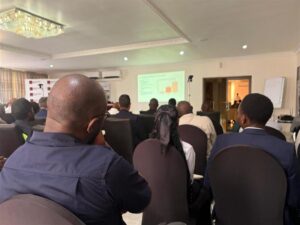
In March 2026, Tincol Mining Laboratory Consumables attended the AZMEC 2026 Explorer’s Forum – one of Africa’s most significant gatherings of mining companies, explorers, investors and government stakeholders.
We were as active participants in a conversation that matters: how does Africa build a mining sector that retains, refines and reinvests the value of its own mineral wealth?
The partnerships being formed at forums like AZMEC are the infrastructure of that future. When African manufacturers, African mining companies and African governments align around local supply chains, the outcome extends far beyond any individual procurement decision. It builds:
- More resilient supply chains that are not vulnerable to global disruption
- Shared technical knowledge that raises laboratory standards across the continent
- Commercial relationships anchored in mutual understanding of local conditions
- Sustainable industry growth that benefits African economies for generations
Tincol Mining is actively pursuing partnerships with mining operations, assay laboratories and mineral testing facilities across Sub-Saharan Africa. We supply to South Africa, Zambia, the DRC, Ghana, Zimbabwe, Botswana, Namibia, Tanzania, Mozambique and beyond and we are committed to expanding that reach through partnerships built on shared purpose.
Africa’s mineral wealth doesn’t need to leave the continent to be refined. It needs the right supply chain behind it.
The Conversation Continues
Africa’s mining future will not be built by extraction alone. It will be built by the decisions made at every level of the supply chain, including the decision about where to source a geo-envelope.
Over time, across operations, across countries, they shape whether African mining is an industry that extracts and exports raw potential, or one that refines it, and keeps the benefit.
Tincol is one part of that answer. The partnerships forming across the continent are another. The conversations happening at forums like AZMEC are another still.
If you are a mining operation, laboratory manager, procurement team or industry partner looking to build a more reliable, more locally grounded supply chain — we want to talk.
From Raw Potential to Refined Impact.
Turn your network into income—apply to our affiliate program!